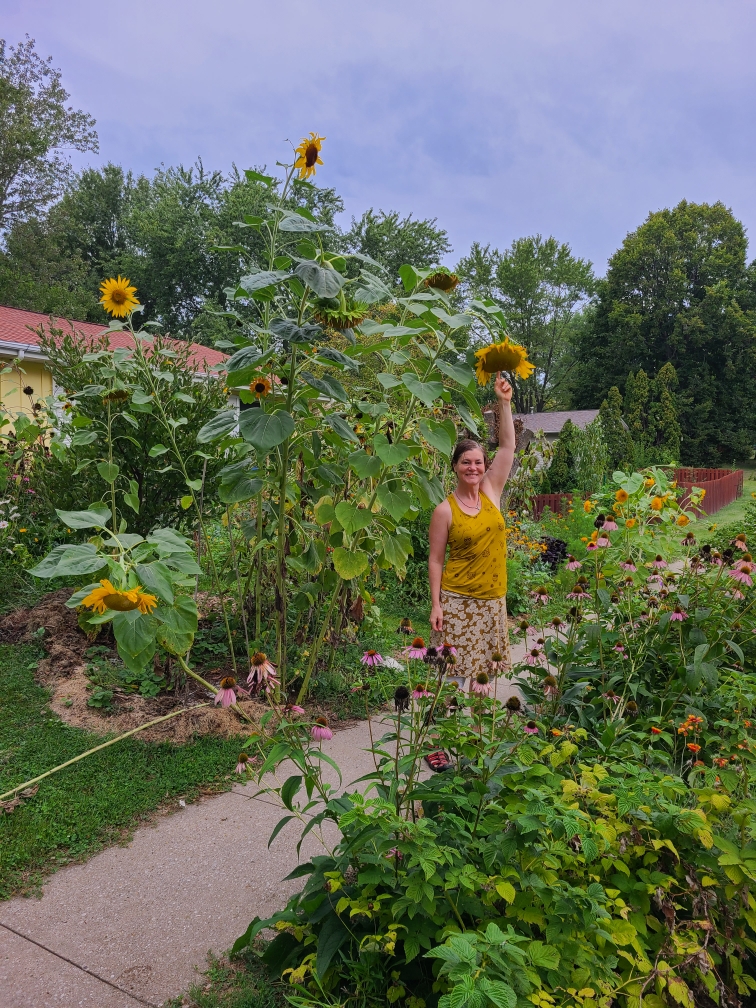
There is no end of joy and sorrow in gardening. Last year the late fall flowers were dripping in orange aphids that left the stalks weeping in dewy sap. This year it was a black carpet of life-draining insects darkening the underbellies of the leaves on my cherry tree. My partner Dan wondered at the care with which I washed each leaf on the three-year-old tree. I might have cherries next year, and that’s good for me and for the birds around here too. This year there were no cherries, but other parts of the garden provided. There are 42 pounds of potatoes, dozens of juicy red tomatoes, bundles of purple kale, and fistfuls of beans. And despite pesky early summer beetles, I have quarts of raspberries to share through the winter months along with rhubarb and garlic and onions.
The greatest joy is not just this — though it is great to bring in food from the garden and lay it out on the table and store some for the lean months. The big joy for me is that between the plants that feed me there is space to to put in flowers and fruits to feed the critters of this dwindling world. There is space between for sunflowers and milkweed and cardinal flowers and black-eyed Susans and crimson clover where a rabbit nibbles in the mornings. The space that was once all grass soaked in herbicides now supports wildlife from aphids to goldfinches, from honey bees to rabbits and even me.
And there are the humans too who feast with their eyes, slowing down as they walk by. And their dogs sniff and their children pause, and sometimes when I am outside while they are passing by we talk to one another.
This week I swapped life stories with a woman who, like me, has just sent her youngest child off to college. We shared lines like poets might, and we wept a little between the beautiful words and the hopes and aspirations we had for our children.
All this as I awkwardly held a sprinkler to one side so it would not get her or me wet. I wasn’t expecting to find a conversation out there among the black-eyed peas, the butternut squash, the mortgage-lifter tomatoes, and the new raspberry canes taking over the planting strip. But once the conversation came upon me, I got caught up in it while holding a hose that I’d planned to set down because at one end was a sprinkler that was a bit on the heavy side and would make a wide spray over both of us if I set it down. I was stuck with holding the hose and directing the spray behind me like spray coming off the back side of a motor boat. I kept eye contact, focused on listening, and tried to be nonchalant so as not to disrupt the conversation or let it slip away or jump loose suddenly from being startled like a deer you suddenly encounter.
Getting into a conversation can be as delicate and uncomfortable as standing still with the sun beating on you and holding a garden hose in your hand with a sprinkler that wants to dance. Suppressing the impulse to rush on to whatever was so important that you didn’t plan to be there so long, and so you want to rush, but you let the hose be awkward and you let yourself get a little hotter in the sun for the precious moment to be in conversation with someone who is as rare as a sighting of a fox in the city. I stayed in position and let the hose go limp and let water spray on thirsty plants behind me, plants as thirsty as we two women were for connection in this time of pandemic.
Earlier in the week in another encounter catalyzed by the front yard garden, I got caught up conversation with an older couple on an evening stroll. The gentleman had a Russian or Slavic accent. Pointing to the thick row of raspberries making themselves at home in the planting strip, he asked, “Do they produce?”
“Yes, yes, quarts and quarts of raspberries for weeks on end,” I said, “you must come back next June to see it,” I trailed off.
“You can make brandy,” he said, and then shared in detail the instructions for layering raspberries or cherries with sugar in jars and putting the jars in the sun for a week, then checking for fermentation, then topping them off with strong alcohol, and finally setting up the jars for 100 days. “That was it,” he said, “and then . . . ,” he paused and lifted his eyes to the fading sky before resuming, “and then, it’s . . .” he gestured kissing his fingers like an Italian might over the taste of perfect sauce.
 Sarah Averill MD
Sarah, what a pleasure to find this lovely little reflection on your gardening experience in my email inbox today. I especially like the image of you holding the sprinkler so it wouldn’t spray you and the neighbor as you talked. This piece makes me reflect on the friendships I’ve made in the neighborhood by walking my dogs–and how precious and sustaining those friendships can be. I’m so glad you’re doing this blog.
LikeLike